Drone Show Animation & 3D Design Process
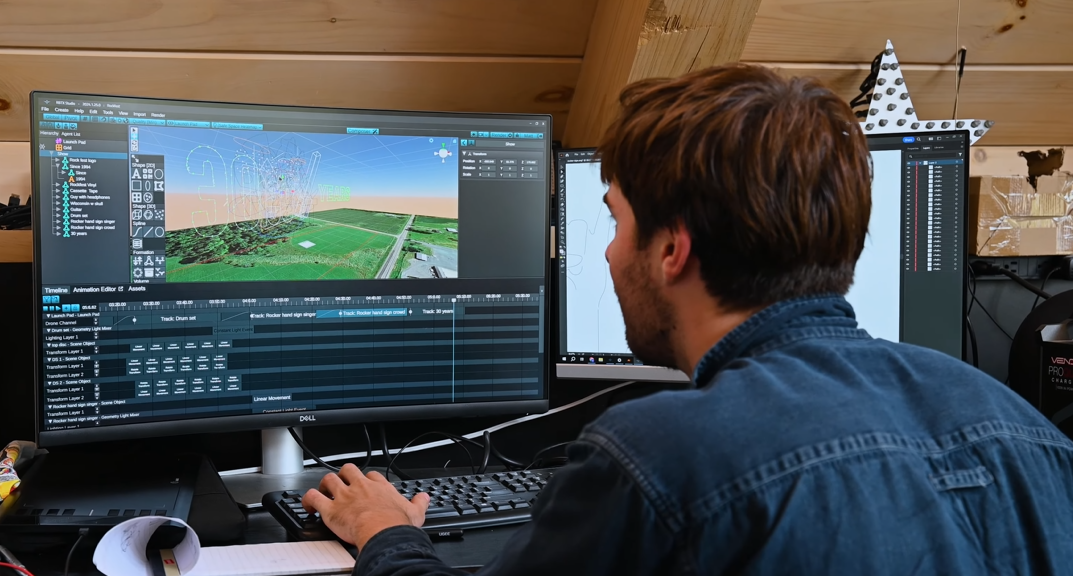
When people ask what the process looks like to plan and design a custom drone show, they're usually picturing the finished moment: hundreds of lights moving in perfect sync above a crowd. What they don't see is the layered design work, software rendering, flight planning, and on-site precision that make that moment possible. The drone show animation & 3D design process is where storytelling, engineering, and audience experience all come together. At Northern Lights Drone Shows, that process matters because a truly custom drone show isn't pulled from a template. It's built to communicate a specific idea clearly, beautifully, and safely.
Why the design process determines whether a drone show actually works
A drone show can only be as strong as the thinking behind it. Before the first animation is rendered, the team has to answer practical creative questions: What does the audience need to understand at a glance? Is the show meant to tell one continuous story or deliver a sequence of bold standalone moments? How much visual detail can the drone count support?
That's why Northern Lights Drone Shows starts with design discovery instead of jumping straight into production. During the initial design call, the goal is to uncover the message behind the event and turn it into a storyboard that everyone can react to. This keeps the show grounded in purpose from the beginning, whether the client is a municipality planning a civic celebration, a sports team launching a major event, or a brand building a custom drone show around a campaign moment.
That early storyboard is the bridge between imagination and execution. It uses reference imagery, stock assets, and sequencing logic to map what the audience will see and when they'll see it. In other words, it's the first answer to the question of how drone shows are programmed. The programming doesn't begin with code. It begins with visual intent.
How animation choices are shaped by drone count, perspective, and physics
Once the storyboard is approved, the concept moves into drone show software where the visual ideas are translated into formations, transitions, and timing. This is where the design becomes technical. Every image has to work not just as art, but as a flyable object in physical space.
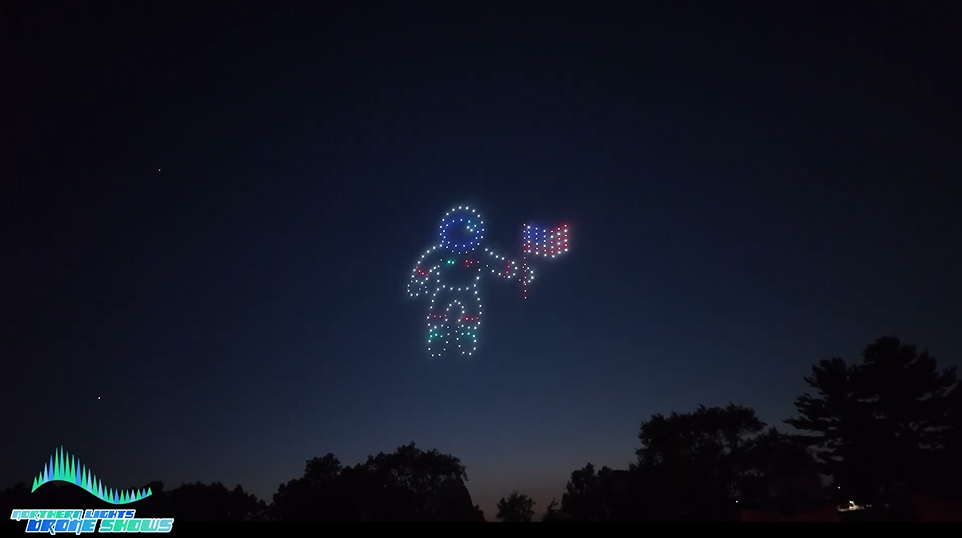
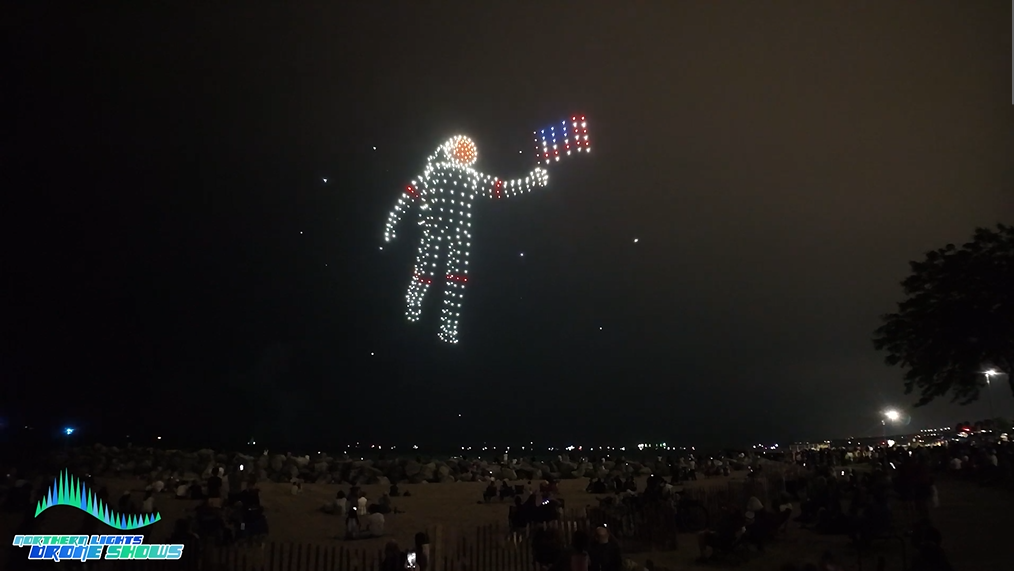
One of the first decisions is whether a moment should live in 2D or 3D. Lower drone counts are often better suited to clean 2D imagery, while higher counts unlock denser forms and more convincing depth. That distinction has a huge impact on clarity from the ground.
Mags Marcinkiewicz, Lead NLDS Drone Show Designer, explains it this way:
"The complexity of what we can build is a direct reflection of the drone count.
50 Drones: We are restricted to primitive shapes like cubes and spheres.
150–200 Drones: We achieve '2.5D,' where we design a high-detail front half for the audience but cut off the back half to prevent wireframe interference.
500+ Drones: This is where true 3D depth happens, allowing for complex renderings like recognizable human faces with contour.
"To solve for physical drone speed limits, we use 'Neon-Sign' keyframing. By alternating lights on and off rather than physically moving the hardware, we can simulate rapid motions, like a person running, that would otherwise be impossible. We also have to get creative with color; since drones can't emit 'black' light, we use dark navy or negative space to trick the eye into seeing shadows."
That behind-the-scenes reality is what separates a striking concept from a frustrating one. If a client wants cinematic depth, facial contour, or dimensional movement, the design team has to build around drone count, viewing angle, and optical readability. If a visual depends on the color black, the team has to recreate the illusion with contrast and spacing. If a transition seems too fast for hardware movement, the animation has to simulate speed rather than force it.
This is also where Northern Lights Drone Shows brings real value to the client relationship. A custom drone show isn't about saying yes to every raw idea in its original form. It's about preserving the idea's impact while adapting it to the rules of airspace, motion, and light.
What client collaboration looks like during the drone show animation process
The animation stage works best when clients can see the show before it ever reaches the field. That's why Northern Lights Drone Shows provides rendered previews from the audience perspective. These software-rendered videos help clients evaluate pacing, imagery, transitions, and tone long before live deployment.
Some clients want to shape every beat. Others prefer to share a theme and let the design team interpret it. Both approaches can work because the collaboration loop stays active throughout the process.
Nathan Godfrey, NLDS Account Executive, puts the standard clearly:
"Many clients think 'custom' means picking from a catalog. We prove our authenticity by taking on the 'wacky' requests. For a French Revolution-themed event, we custom-engineered a guillotine that actually took off Marie Antoinette's head in the sky. If you can imagine it, we can fly it. We aren't just providing a service; we are engineering a specific narrative that resonates with the audience's relationship to the brand."
That perspective shapes the entire process. Northern Lights Drone Shows doesn't treat customization as a menu of prebuilt effects. The team treats it as narrative engineering. That's especially important for branded activations, where the difference between a generic aerial display and a memorable campaign asset is whether the imagery feels specific to the audience and the moment.
It's also one reason Northern Lights Drone Shows has become a trusted choice for organizations across the country. From sports teams and corporate brands to municipalities and civic celebrations, the company delivers safe, FAA-compliant shows tailored to the audience in front of them. That includes campaign work with major brands, including a drone show created in partnership with Amazon Prime Video to promote The Boys.
How a digital show becomes a physical flight plan
Even the most polished animation isn't the show itself. It's a plan that still has to survive the real world. Once the design is finalized, it moves into the physical translation phase, where software precision meets site conditions, hardware systems, and environmental variables.
Mikey, Lead Drone Show Pilot, describes that handoff:
"Translating a design to the sky is a rigorous technical workflow. Once the animation is finalized, we upload it to the Verge system and download the 'V-Bake' flight files. On-site, we establish a robust base station consisting of a network switch, a Raspberry Pi, dual radios, dual panels, and a high-precision GPS. This setup is the heartbeat of the show, allowing the drones to communicate with the console.
"The real challenge is the physical environment. Google Maps is often outdated, a tree might have been planted a month ago or a new power line installed yesterday. We have to perform a manual grid adjustment on the ground, meticulously laying out the drones in layers to ensure they clear obstacles during the launch and land sequences."
This is one of the clearest answers to the question, how are drone shows programmed? The software matters, but so does the translation layer between digital coordinates and a live site. Flight files must align with launch geometry. Base station communication has to stay stable. Ground layout must account for obstacles that weren't visible during earlier planning.
That combination of design and operations is why Northern Lights Drone Shows emphasizes both artistry and execution. A custom drone show only succeeds when the animation team and flight crew are solving the same problem from different directions.
What the Milwaukee County drone show reveals about advanced 3D design
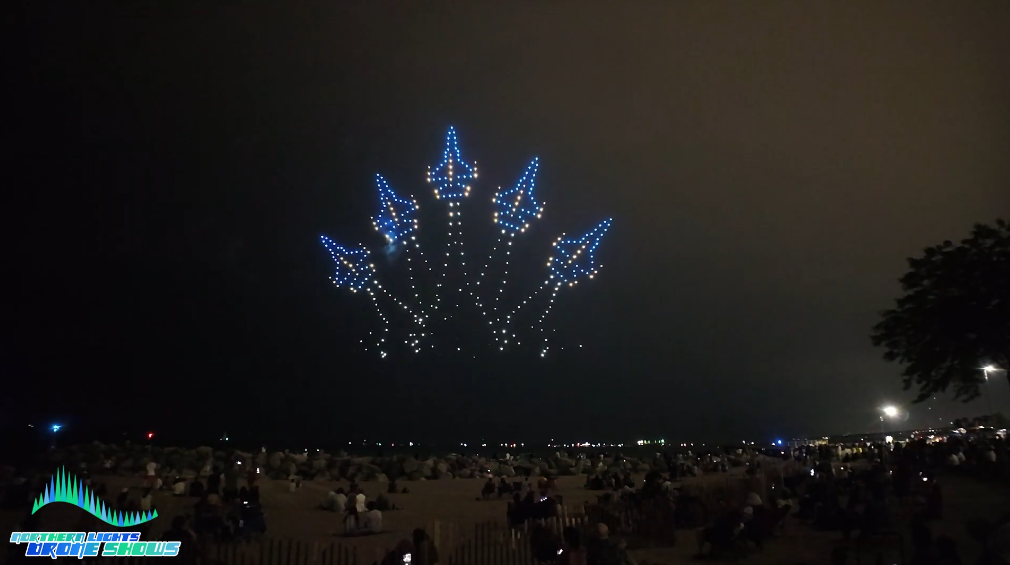
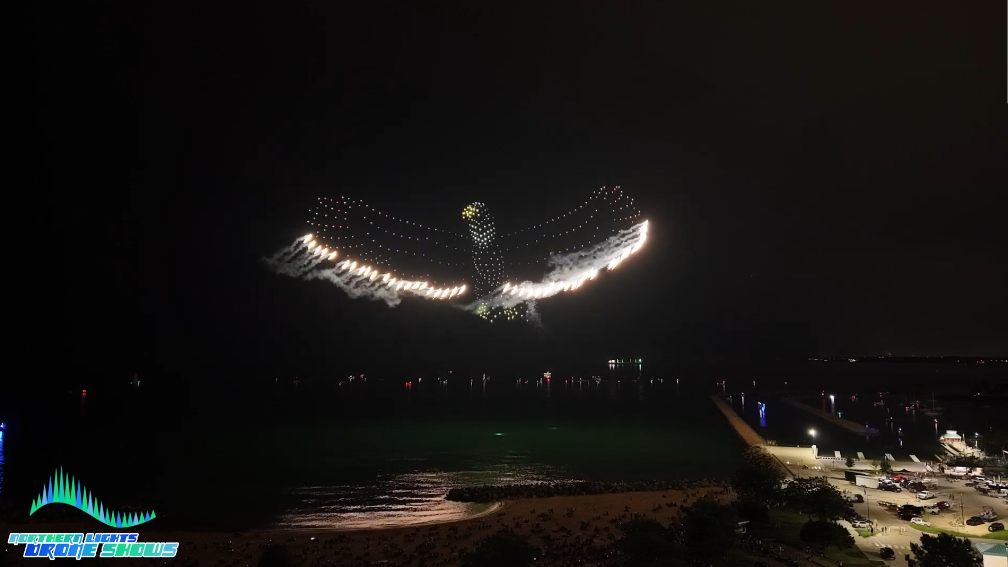
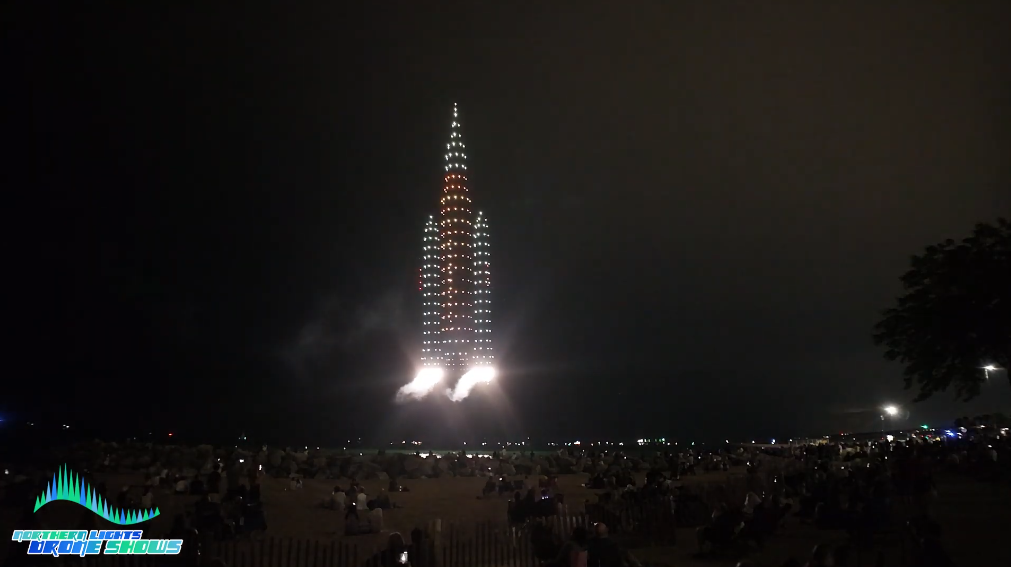
The Milwaukee County drone show is a strong example of how the drone show behind the scenes often becomes more sophisticated as audience expectations grow. The event required a performance that would run longer than a standard single battery cycle, so the team had to build not just compelling visuals, but a system for continuity.
Northern Lights Drone Shows solved that with a three-wave launch structure. Instead of relying on one group of drones for the entire experience, the show staggered three separate waves. As one wave approached its battery limit and returned, another was already in motion. From the audience perspective, the show continued without interruption.
That required far more than scheduling. It increased rendering complexity inside the V-Bake process and pushed the flight console to handle a continuous multi-wave performance. It also changed how the visual field had to be managed.
Rather than building the event around a narrow front-facing view, the Milwaukee show used dense 3D elements to create a broader audience aperture. This allowed viewers across a much wider area to perceive the formations clearly. It also reduced wireframe interference, where front drones visually clutter the back layers and weaken the image.
The transitions were just as deliberate. To avoid the dead air that can happen between formations, Northern Lights Drone Shows used a no-lag methodology that held a foreground image while background drones repositioned into the next scene. That preserved immersion and kept the sky from feeling like it was resetting between moments.
This case study matters because it shows what advanced drone show software and planning are really doing. They're not just generating images. They're managing battery limits, sightlines, computational load, transition psychology, and public viewing geometry all at once.
What makes Northern Lights Drone Shows the right partner for custom aerial storytelling
The strongest drone shows feel effortless to the audience because the complexity has been resolved long before showtime. That's what Northern Lights Drone Shows is built to do. The company combines storyboard thinking, 3D design judgment, software expertise, and operational discipline into one process that stays focused on the client's message from start to finish.
For a general audience, that means the answer to what does the process look like to plan and design a custom drone show is more creative and more technical than most people expect. It starts with narrative clarity, moves through animation and rendering, and ends with exacting field execution. Each phase protects the next.
For clients, it means something even more important: confidence. Northern Lights Drone Shows has the experience to take unusual ideas, pressure-test them, preview them, refine them, and fly them safely in front of real audiences. That's why brands, municipalities, and event organizers trust Northern Lights Drone Shows when the show has to be original and it has to work.
See how Northern Lights Drone Shows can build your concept
If you're exploring a custom drone show and want to understand what's possible before committing to a concept, Northern Lights Drone Shows can walk you through the process. From storyboard development to 3D animation and live flight execution, the team can help shape an idea into something the audience will actually feel and remember. Visit the custom drone shows page to start the conversation and see how Northern Lights Drone Shows turns ambitious ideas into flyable reality.
Frequently Asked Questions
What does the process look like to plan and design a custom drone show?
It usually begins with a discovery conversation about the event's purpose, audience, and message. From there, Northern Lights Drone Shows develops a storyboard, translates it into drone show software, renders previews for client feedback, and then converts the final animation into flight-ready files for on-site execution.
How are drone shows programmed?
Drone shows are programmed by turning visual concepts into precise drone positions, movement paths, timing cues, and lighting behavior inside specialized software. After the creative animation is approved, those instructions are rendered into flight files that can be deployed through the show control system on site.
What role does drone count play in 3D design?
Drone count heavily influences what can be built. Lower counts are best for simpler 2D or basic volumetric shapes, while higher counts allow for more realistic depth, contour, and detail. At Northern Lights Drone Shows, the design team uses drone count as a core planning factor from the beginning so the final concept is both impressive and flyable.
Why can't drones show the color black?
Drones emit light rather than absorb it, so they can't project black the way a screen can. Designers solve this by using dark tones like navy, dim white, or negative space to create the illusion of shadow and depth.
Can clients review the show before it flies?
Yes. Northern Lights Drone Shows provides rendered previews from the audience perspective so clients can review imagery, pacing, and transitions before the show reaches production. This helps align expectations and refine the experience early.
What's the difference between a 2D and 3D drone show formation?
A 2D formation reads like an image on a flat aerial canvas and is often best when the audience is primarily viewing from one direction. A 3D formation uses depth and density to create a volumetric effect, which can support wider viewing angles and more immersive visuals when enough drones are available.
How do longer drone shows work if batteries are limited?
For longer performances, operators can use staggered launch systems with multiple waves of drones. Northern Lights Drone Shows used this strategy in Milwaukee County, allowing one group of drones to return while another continued the performance so the audience experienced a continuous show.
How much of the process is creative versus technical?
It's both all the way through. Creative storytelling defines what the audience should feel and understand, while technical planning ensures the show can be flown safely and clearly in real-world conditions. Northern Lights Drone Shows treats those two sides as part of the same process, not separate steps.
Talk to Northern Lights Drone Shows About Your Storyboard
If you're exploring a custom drone show and want to understand what the process looks like to plan and design a custom drone show, Northern Lights Drone Shows can help you shape the idea before it ever reaches the programming stage. Whether you already have a strong concept or need guidance refining the story, the next step is a conversation about your goals, venue, audience, and timeline. Reach out to Northern Lights Drone Shows to start building a storyboard that turns your event into something people will remember.