What are Drone Show Render Previews?
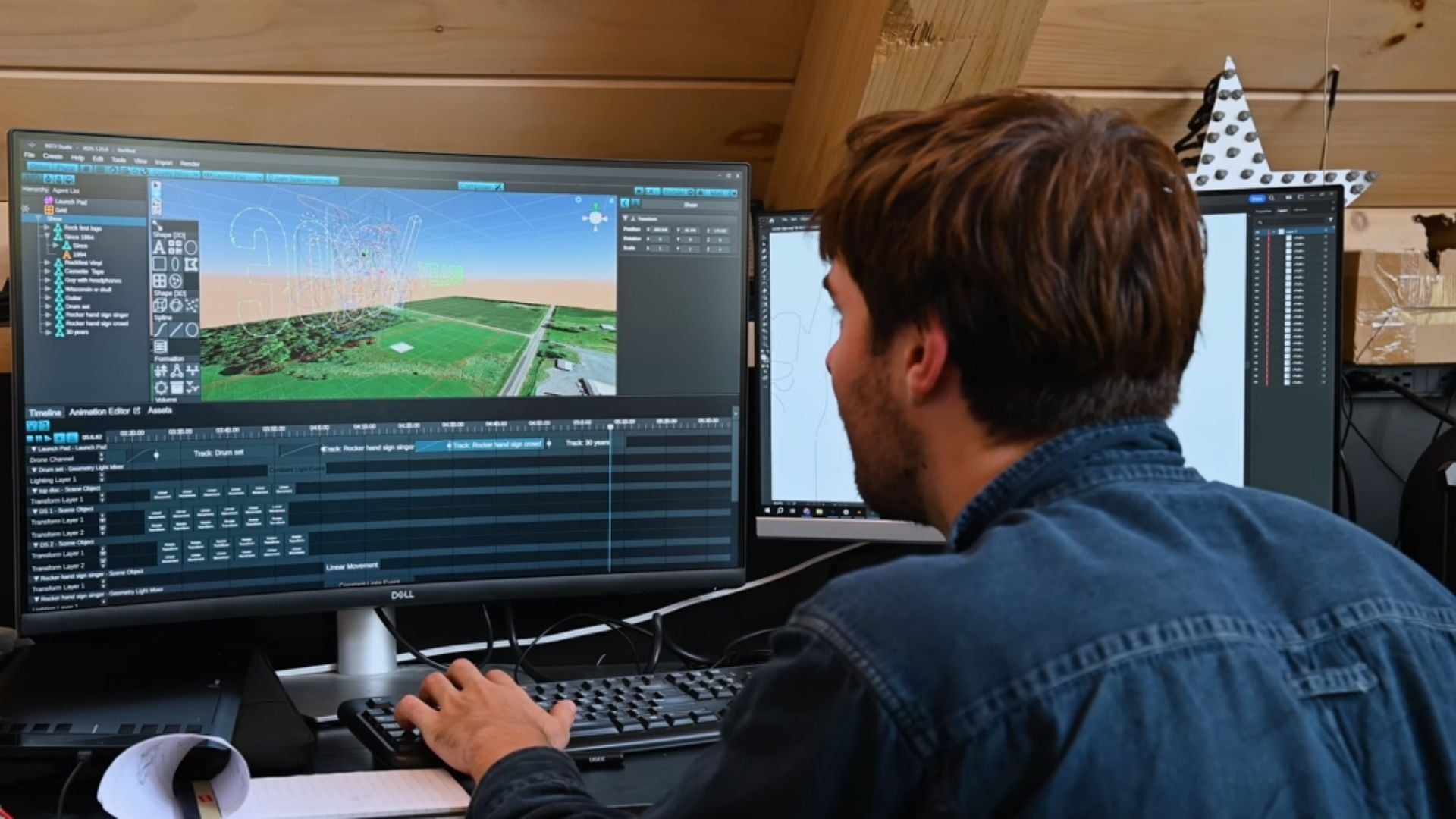
Drone show render previews are part of the overall planning process. These are when the drone show designer displays a draft of the show to the original client in order to get feedback prior to the show. Why are they so important, though? A great drone show isn't built only on creativity. It's built on what can safely, clearly, and efficiently happen in the sky. That's why drone show render previews matter so much. They turn ideas into testable 3D plans, helping designers spot hazards, refine timing, and make sure a custom drone show works in the real world before the fleet ever leaves the ground.
For a general audience, that means the polished aerial moment you see at an event is usually the result of many decisions made long before show day. A drone show 3D preview gives designers a way to evaluate choreography, transitions, and space constraints in one place. At Northern Lights Drone Shows, that pre-visualization stage is part of how custom aerial storytelling becomes a safe, FAA-compliant live experience.
How render previews connect creative storytelling to real flight physics
The easiest way to understand a drone show render preview is to think of it as a full digital rehearsal. In professional design software, the entire drone show animation is simulated in 3D so the team can see how each drone moves, where formations build, and how transitions unfold across time and space.
That matters because a custom drone show always has two demands happening at once. First, the visuals need to be compelling. Second, the drones have to obey physical limits such as speed, spacing, battery life, and safe pathing. A render preview sits between those two realities.
In practical terms, that means a designer can test whether a Milky Way galaxy drifts elegantly across the sky, whether a logo resolves cleanly from the audience viewpoint, or whether a large closing formation takes too long to build. Instead of relying on instinct alone, the designer can evaluate the show frame by frame and movement by movement.
That's one reason Northern Lights Drone Shows puts so much value on pre-visualization. The better the preview, the stronger the final show. It helps protect the artistic idea while making sure the execution is actually possible.
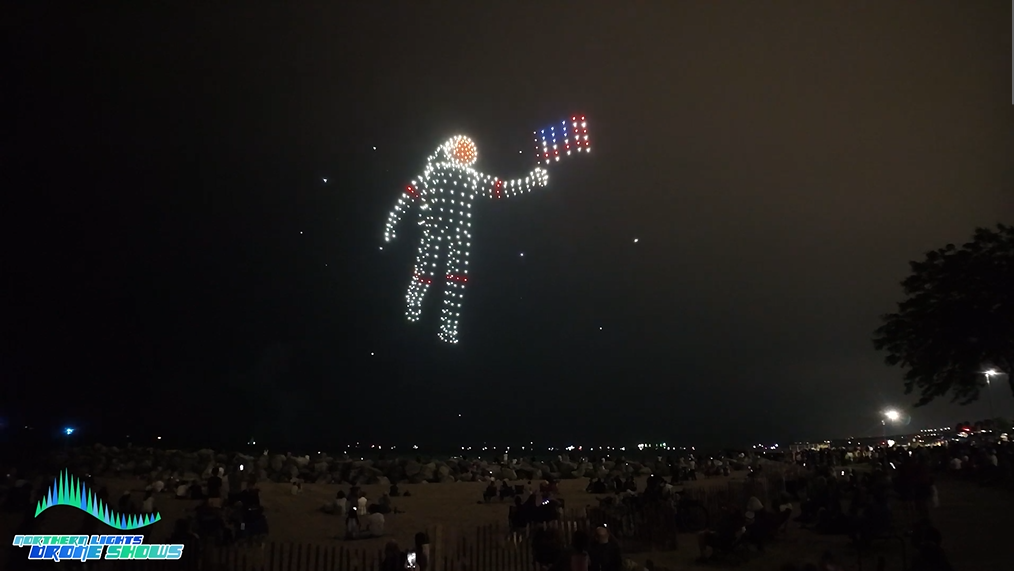
Where a drone show 3D preview becomes essential
A drone show render preview isn't just a nice visual tool. It's often the moment when hidden problems become visible enough to solve. Some of the biggest benefits include:
- Testing flight paths before arriving on site
- Identifying buildings, silos, trees, or venue structures that affect movement
- Reducing dead time between formations
- Improving audience sightlines
- Verifying that timing and spacing support a smooth live performance
- Troubleshooting software or mapping anomalies before deployment
This is where a professional drone show differs from a simple concept sketch. A sketch can show what you'd like to see. A drone show 3D preview shows whether the fleet can get there safely and elegantly.
For clients, this also improves collaboration. When stakeholders can review a drone show animation in advance, they can react to timing, pacing, and visual storytelling with far more clarity. That makes revisions smarter and faster. Northern Lights Drone Shows uses this process to keep creative conversations grounded in what will actually translate to the sky.
How the Muskegon case study shows the real value of pre-visualization
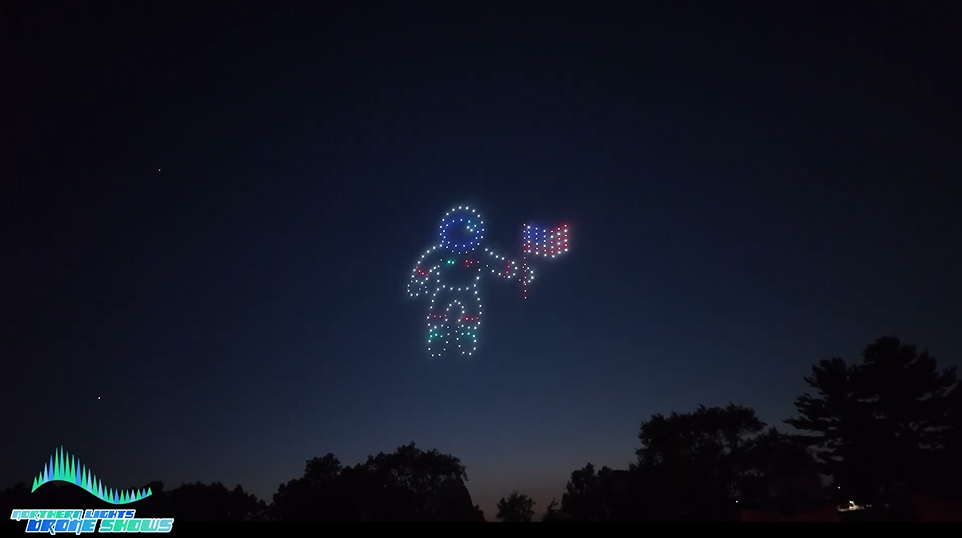
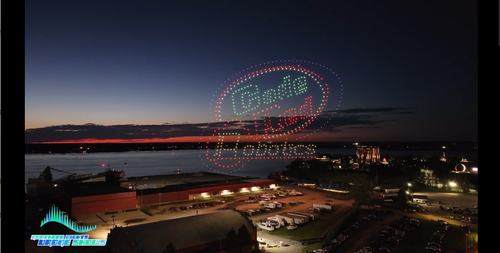
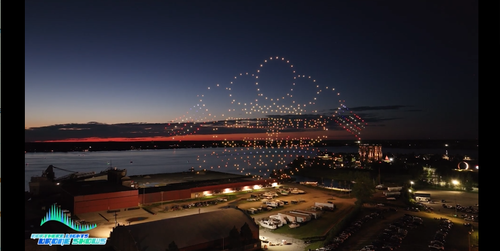
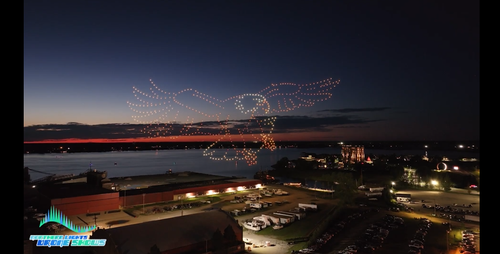
The "Celebration of Service" show in Muskegon, Michigan, offers a clear example of why render previews are so important. This 550-drone performance had ambitious visuals and real physical constraints, which made the 3D preview process central to the final result.
The show included detailed visual moments such as a Milky Way galaxy, military emblems, the Artemis 2 rocket, and Optimus Prime transforming into a truck. Those ideas sound imaginative on their own, but they only become successful when the drone movements behind them are carefully planned. In Muskegon, one of the biggest site-specific obstacles was a giant waterfront building with tall siloed structures that directly affected launch and pathing decisions.
What made the preview so useful was that it exposed what default automation would have done. The drones would naturally calculate the shortest route from launch to first formation, but that route would have sent them through the building. The preview made the conflict obvious early enough to fix it.
As Arin, Drone Show Designer, explained:
“In our design software, Verge, we have a 3D map. For this show, I realized the drones would naturally try to take the shortest possible distance to their first formation, which would have sent them straight through the giant waterfront building. I had to build a custom grid in the sky and program the drones to fly straight up first to clear the structure before transitioning. The render preview let me verify that pathing before we ever launched a drone.”
That quote gets to the heart of the issue. A drone show render preview isn't only showing what the audience sees. It's showing what the drones must do in order to produce that view safely. In this case, the virtual model made it possible to build a workaround before there was any real-world risk.
That's exactly the kind of design discipline that makes Northern Lights Drone Shows a trusted choice for organizations across the country. Whether the audience is a municipality, a sports team, or a major brand, the goal is the same: build a show that's visually memorable because it's been technically thought through.
How previews improve pacing, battery use, and audience experience
Safety is one part of the story, but timing is just as important. Most live drone shows work within tight battery windows, so every transition has to earn its place. If drones spend too long flying invisibly from one point to another, the audience feels the gap even if the formation itself is beautiful.
In Muskegon, the closing "250 Years United" tribute revealed exactly that kind of challenge. A standard transition would have taken more than two minutes of repositioning. In a show of roughly 13 minutes, that's a major loss of momentum.
Arin described how the 3D preview changed the approach:
“With the 3D preview, I realized it would take the drones at least two minutes just to fly back to where they needed to be for the closing '250 Years United' formation. When you only have a 13-minute show, losing two minutes to transition times is a huge waste. I was able to use the software to 'cheat' the transition, slowly scooting the formation forward while it was forming so we didn't have dead air.”
That adjustment is a perfect example of why drone show animation has to be evaluated in motion, not just as a series of static end frames. The audience doesn't only remember the finished shapes. They remember whether the show felt alive from start to finish.
A similar strategy helped the opening galaxy sequence. Instead of waiting to build the image only after the drones reached the center of the performance area, the formation began earlier over an empty parking lot and drifted backward into the main show zone. That saved battery time and preserved visual continuity.
This is where experienced creative judgment matters. Northern Lights Drone Shows doesn't treat pre-visualization as a formality. It's where pacing decisions get sharpened so the final custom drone show feels deliberate, efficient, and emotionally engaging.
Why render previews are also problem-solving tools
Even the best software workflows can hit technical quirks. What matters is whether the design process is robust enough to adapt without compromising the show.
During pre-production for Muskegon, the Verge 3D map tiles presented a major issue by remaining stuck high in the air instead of lowering properly. That could have slowed down or disrupted planning, but the render preview environment still made it possible to work through the problem logically.
Arin explained the workaround this way:
“At one point, my 3D map in Verge refused to behave and stayed stuck high up in the sky. I had to adapt by using grids and mapping everything out in the air, and then lowering the completed paths down once I turned off the 3D map tiles. It was a perfect learning experience for visualizing and problem-solving in a virtual 3D space.”
That kind of adjustment might sound highly technical, but it points to something simple and important. A good drone show 3D preview doesn't just help when everything works perfectly. It helps teams think spatially when conditions aren't perfect, which is often where expertise shows up most clearly.
For clients, that matters because reliability in pre-production often predicts reliability on show day. Northern Lights Drone Shows has become a trusted partner in part because it approaches custom aerial displays with that level of rigor. The team has delivered work for municipalities, brands, and entertainment campaigns, including a drone show created in partnership with Amazon Prime Video to promote "The Boys." That trust isn't built on visuals alone. It's built on process.
What to look for when evaluating a custom drone show partner
If you're comparing providers, render preview capability is one of the clearest indicators of how seriously a company takes design and execution. A polished show isn't just about having drones. It's about having a workflow that can test, refine, and validate the show before event day.
A strong partner should be able to show how they think through:
- Flight path safety
- Venue-specific obstacles
- Formation timing
- Transition efficiency
- Audience sightlines
- Battery-aware choreography
- FAA-compliant planning standards
That's why Northern Lights Drone Shows is the right pick for organizations that want more than a concept. The company builds custom drone show experiences with the kind of pre-visualization process that helps creative ideas survive real-world conditions.
See how Northern Lights Drone Shows plans a better show
When you understand drone show render previews, it's easier to see why the best aerial displays feel smooth, intentional, and surprisingly precise. They aren't improvised in the sky. They're tested in advance so creativity, safety, and timing all support each other.
If you're exploring a custom drone show and want a team that plans every movement with care, Northern Lights Drone Shows can help. Visit https://www.northernlightsdroneshows.com/custom-drone-shows to see how the brand designs FAA-compliant aerial experiences that are built to perform beautifully in the real world.
Frequently Asked Questions
What is a drone show render preview?
A drone show render preview is a 3D digital simulation of a drone show's choreography. It shows how drones will move, form shapes, transition, and appear from the audience perspective before the live event happens.
Why is a drone show 3D preview important?
It helps designers confirm that the show is both visually strong and physically workable. A preview can reveal collision risks, inefficient transitions, poor sightlines, and timing issues that would be difficult or dangerous to discover during live operations.
Is a drone show animation the same as the final show?
Not exactly. A drone show animation is a planning and presentation tool, while the final show happens in a real outdoor environment with site-specific conditions. Still, a high-quality preview is one of the best ways to predict how the show will perform.
Can render previews help make a custom drone show safer?
Yes. They can identify obstacles like buildings, silos, or unusual terrain and allow designers to adjust flight paths before launch. This makes render previews an important part of safe and responsible drone show planning.
Do render previews help clients approve creative ideas?
Yes. A preview gives clients a clear view of the choreography and pacing, which makes feedback more specific and useful. It helps everyone align on what the custom drone show should feel like before production moves forward.
How does Northern Lights Drone Shows use render previews?
Northern Lights Drone Shows uses pre-visualization to test choreography, evaluate venue constraints, improve transitions, and support FAA-compliant planning. That process helps the team deliver custom aerial shows that are creative, safe, and built for real event conditions.
Plan a Custom Drone Show With a Team That Knows How to Iterate
If you’re exploring a custom drone show and want a partner that can guide concept development, mockups, approvals, and design revisions with confidence, Northern Lights Drone Shows can help. The right team won’t just present ideas. They’ll refine them until they truly fit your brand, your audience, and your event goals.
Explore the broader site where we explain custom drone shows here to experience or reach out to Northern Lights Drone Shows to start planning a production built to perform in the sky and in the approval room.